Wikipendium

Share on Twitter Create compendium Add Language
Edit History
Tools
  • Edit
  • History
  • Share on Twitter

  • Add language

  • Create new compendium
Log in
Table of Contents
  1. Complex numbers
    1. Modulus
    2. Argument
    3. Polar form
    4. Multiplication
    5. Division
    6. Complex form
    7. Roots
    8. Complex functions
  2. Second order linear differential equations
    1. Linear, homogenous equations with constant coefficients
      1. Distinct real roots
      2. Complex roots
      3. Repeated roots
    2. Inhomogeneous equations
    3. Harmonic oscillator
  3. Vectors
    1. Normalization of vectors
  4. Matrices
    1. Terminology
    2. Linear transformations
      1. Onto and one-to-one
    3. Inverse of a matrix
    4. LU factorization
    5. Determinants
    6. Eigenvalues and eigenvectors
      1. Eigenvalue
        1. Definition
        2. An example of finding the eigenvalues of a matrix
      2. Eigenvectors
      3. 2D rotation matrix
    7. Column Space and Null Space of a Matrix
      1. Basis
    8. Orthogonality
      1. Orthogonal complement
      2. Orthonormal set
      3. Projection
      4. The Gram-Schmidt process
      5. QR factorization
    9. Symmetric matrices
  5. Useful links
‹

TMA4115: Calculus 3

Tags:
  • 3
  • matematikk
  • matte-3
  • matte 3
  • matte3
  • calculus
  • maths
+

Complex numbers

"A complex number is a number that can be expressed in the form $a + bi$, where $a$ and $b$ are real numbers and $i$ is the imaginary unit" -wikipedia.org

$$ i = \sqrt{-1} $$ $$ i^2 = -1 $$

$$ Re(a + bi) = a $$ $$ Im(a + bi) = b $$

Modulus

Essentially the length of the vector from the origin to $(a, b)$. $$|w| = |a + bi| = \sqrt{a^2 + b^2}$$

Argument

The line from the origin to (a, b) has an angle $\theta$. This is called the argument and is denoted by arg $\theta$. The principal argument Arg $\theta$ (with the initial letter capitalized) is the value in the interval $(−\pi, \pi]$

Polar form

Given $r = |w|$ and $\theta = arg\:w$ $$w = r\:cos\:\theta + i\:r\:sin\:\theta$$

Multiplication

$$ |wz| = |w||z| $$ $$ arg(wz) = arg(w) + arg(z) $$

Division

$$ \left|\frac{z}{w}\right| = \frac{|z|}{|w|} $$ $$ arg\left(\frac{z}{w}\right) = arg(z) - arg(w) $$

Complex form

Euler's formula: $$ e^{ i\theta } = \cos \theta + i\sin \theta $$

Based on that formula, we can write a complex number $w$ in complex form. $$r = |w|$$ $$\theta = Arg\;w$$ $$w = r\,e^{i\theta + 2 \pi i k} = r\,e^{i(\theta + 2 \pi k)}$$ where $k = 0, \;\pm 1, \;\pm 2, \;\dots$

Roots

When finding the $n$th roots of a complex number $w$, we can find $n$ roots. These $n$ roots are distinct complex numbers. For example, let's find $\sqrt[3]{w}$ where $w = 4 + 4i$. We expect to find 3 roots.

First, write $w$ in complex form: $$ r = |w| = \sqrt{4^2 + 4^2} = \sqrt{32} $$ $$ \theta = arg(w) = tan^{-1}\left(\frac{4}{4}\right) = \frac{\pi}{4} $$ $$ w = \sqrt{32} \: e^{i(\pi/4 + 2 \pi k)} $$ where $k = 0, \;\pm 1, \;\pm 2, \;\dots$

Next comes the most important step: raise both sides to the power of $\frac{1}{3}$: $$ w^{\frac{1}{3}} = \left(\sqrt{32} \: e^{i(\pi/4 + 2 \pi k)} \right)^{\frac{1}{3}} $$ $$ \sqrt[3]{w} = \sqrt{32}^{\frac{1}{3}} \: e^{\frac{1}{3} i(\pi/4 + 2 \pi k)} $$ Finally insert $k = 0, 1, 2$ to get the three 3rd roots of $w$ respectively.
Note: If you try to insert $k = 3$, you'll see that it gives the same root as $k = 0$

Complex functions

$$ \cos{z} = \frac{e^{iz} + e^{-iz}}{2} $$ $$ \sin{z} = \frac{e^{iz} - e^{-iz}}{2i} $$

Second order linear differential equations

Linear, homogenous equations with constant coefficients

$$ y''+py'+qy=0 $$ Solve $\lambda^2+p\lambda+q=0$

Distinct real roots

$$y(t)=C_1 e^{\lambda_1t}+C_2 e^{\lambda_2t}$$ Where $C_1$ and $C_2$ are arbitrary constants.

Complex roots

$$ \lambda = a \pm bi $$ $$ y_1 = e^{at} cos\: bt $$ $$ y_2 = e^{at} sin\: bt $$ $$ y(t) = A_1y_1(t) + A_2y_2(t) = e^{at} (A_1 \cos bt + A_2 \sin bt) $$

Repeated roots

$$\lambda=-p/2$$ $$y_1(t)=e^{\lambda t}$$ $$y_2(t)=te^{\lambda t}$$ $$y(t)=(C_1+C_2t)e^{\lambda t}$$

Inhomogeneous equations

The inhomogenous linear equation $$ y''+py'+qy=f $$ Has the general solution: $$ y=y_p+C_1y_1+C_2y_2 $$ Where $y_1$ and $y_2$ are solutions to the associated homogenous equation $$ y''+py'+qy=0$$ and $y_p$ is a particular solution to the inhomogenous equation $$ y''+py'+qy=f$$

In order to find $y_p$, you can use one of the following methods:

  • Undetermined coefficients
  • Variation of parameters

Harmonic oscillator

$$E: y'' + 2cy' + w_0^2 y = cos(wt)$$ $$E_h: y'' + 2cy' + w_0^2 y = 0$$

Step 1:
Solve the homogenous equation by solving the characteristic equation

$$\Delta = 4c^2 - 4w_0^2$$

if $\Delta < 0$: Underdamped (Oscillations. Goes to halt slowly.)

if $\Delta = 0$: Critically damped (the fastest way the system goes to halt)

if $\Delta > 0$: Overdamped (an exponential function that slowly approaches 0)

Step 2:
Compute $y_p$ by using undetermined coefficients

$$ y_p = A \:cos(wt) + B \:sin(wt) $$

General solution: $$y = y_h + y_p$$ where $y_h$ tend to 0. It is the transient term. $y_p$ will keep oscillating. It's called the steady state of the system.

Vectors

A vector in this subject is always thought of as a column vector, and is written as such: $$ \vec{v} = \begin{bmatrix} v_1 \\ v_2 \\ \vdots \\ v_n \end{bmatrix} $$

Normalization of vectors

When we normalize a vector we are making the length of the vector $1$ (for the zero vector, with length equal to zero, this is not possible). This is an important operation in regards to steady-state vectors and computer graphics. A normalized vector is also called a unit vector.

$$ \vec{\hat{v}} = \frac{\vec{v}}{\begin{Vmatrix} \vec{v} \end{Vmatrix}} $$ Where $\begin{Vmatrix}\vec{v}\end{Vmatrix}$ is the length of the vector: $$ \begin{Vmatrix}\vec{v}\end{Vmatrix} = \sqrt{v_1^2 + v_2^2 + \dots + v_n^2}$$

Matrices

Terminology

For example, when a text says "Suppose a 4 x 7 matrix A (...)", that means that m = 4, n = 7. Can't remember the order? Rule of thumb: Just remember the word "man" and that m comes before n. m is the height of the matrix, and n is the width of the matrix.

Linear transformations

A matrix can be regarded as a transformation that transforms a vector. For example, a transformation $T$ can double the length of a 2D vector. Such a transformation $T$ and its standard matrix $A$ would look like this:

$$ T(x) = 2x $$ $$ A = \begin{bmatrix} 2 & 0 \\ 0 & 2 \end{bmatrix} $$

Onto and one-to-one

Let $A$ be the standard matrix of a transformation $T\; : \; \mathbb{R}^n \; \rightarrow \; \mathbb{R}^m$

  • $T$ is onto if and only if the columns of $A$ span $\mathbb{R}^m$. In other words, $Ax = b$ has a solution for each $b$ in $\mathbb{R}^m$.
  • $T$ is one-to-one if $A$ is invertible, i.e. the columns of $A$ are linearly independent.

Inverse of a matrix

The inverse of a matrix $A$ is denoted $A^{-1}$ and is the matrix that one can multiply A with to get the identity matrix.

$$ A^{-1}A = I $$

For example, consider the following matrix

$$ A = \begin{bmatrix} 2 & -1 & 0 \\ -1 & 2 & -1\\ 0 & -1 & 2 \end{bmatrix}. $$

To find the inverse of this matrix, one takes the following matrix augmented by the identity, and row reduces it as a 3 by 6 matrix: $$ [\;A\;|\;I\;] = \left[ \begin{array}{rrr|rrr} 2 & -1 & 0 & 1 & 0 & 0\\ -1 & 2 & -1 & 0 & 1 & 0\\ 0 & -1 & 2 & 0 & 0 & 1 \end{array} \right]. $$

By performing row operations, one can check that the reduced row echelon form of the this augmented matrix is:

$$ [\;I\;|\;B\;] = \left[ \begin{array}{rrr|rrr} 1 & 0 & 0 & \frac{3}{4} & \frac{1}{2} & \frac{1}{4}\\[3pt] 0 & 1 & 0 & \frac{1}{2} & 1 & \frac{1}{2}\\[3pt] 0 & 0 & 1 & \frac{1}{4} & \frac{1}{2} & \frac{3}{4} \end{array} \right]. $$

By this point we can see that B is the inverse of A.

A matrix is invertible if, and only if, its determinant is nonzero.

LU factorization

With this technique, you can write $A = LU$ where $L$ is a lower triangular matrix with ones on the diagonal and $U$ is an upper triangular matrix (echelon form). Do this only if you can reduce A without row exchanges.

First, write down the augmented matrix: $$ [\;A\;|\;I\;] $$ Row reduce it until the left side is in echelon form (not reduced echelon form). You should now have $$ [\;U\;|\;L^{-1}\;] $$ Now, to find L, use your favorite technique for finding the inverse of a matrix.

Why LU factorization?
Because when $A = LU$, and you want to solve $Ax = b$ for $x$, then you can find $x$ by solving these two equations: $$Ux = y$$ $$Ly = b$$ Each of these two equations are relatively simple, and computers are able to solve them faster than solving the more complex equation $Ax = b$

Determinants

The determinant of a 2x2 matrix is simple to compute. Here's an example: $$ A = \begin{bmatrix} a & b \\ c & d \end{bmatrix} = \begin{bmatrix} 4 & 9 \\ 3 & 2 \end{bmatrix} $$ $$ det\: A = ad - bc = 4 * 2 - 9 * 3 = -19 $$

Calculating the determinant of a larger matrix is harder. Look up "cofactor expansion" in your textbook or on the internet. Moreover, here are some useful theorems related to determinants:

  • If $A$ is a triangular matrix, then $det\: A$ is the product of the entries on the main diagonal of $A$.

  • Adding one row of $A$ to another row of $A$ will not change $det\: A$.

  • A square matrix $A$ is invertible if and only if $det\: A \neq 0$.

Eigenvalues and eigenvectors

Eigenvalues and eigenvectors apply to square matrices.

Eigenvalue

Definition

An eigenvalue is a value that satisfies this equation: $$ A \vec{v} = \lambda \vec{v} , \vec{v} \neq 0 $$

To find the eigenvalues you evaluate the definition. $$ A \vec{v} = \lambda \vec{v} $$ $$ A \vec{v} - \lambda \vec{v} = 0 $$ $$ (A - I \lambda) \vec{v} = 0$$

This is where $I \lambda$ is the identity matrix of $\lambda$. To satisfy $\vec{v} \neq 0$ we need to make sure the determinant to $A - I \lambda$ is equal to zero. This will yield a polynomial equation, which when solved will give the eigenvalues.

An example of finding the eigenvalues of a matrix

Given the matrix: $$ A = \begin{bmatrix} 1 & 2 \\ 4 & 6 \end{bmatrix} $$ We want to find the eigenvalues. We have from the definition that the eigenvalues satisfies this equation: $$ \begin{vmatrix} A - I \lambda \end{vmatrix} = 0 $$ We then have: $$ \begin{vmatrix} 1 - \lambda & 2 \\ 4 & 6 - \lambda \end{vmatrix} = 0 $$ Which then gives the polynomial $$(1-\lambda)(6-\lambda)-8=0$$ $$\lambda^2 -7\lambda-2=0$$

The roots of this polynomial are $\frac{1}{2}(7-\sqrt{57})$ and $\frac{1}{2}(7+\sqrt{57})$, which are the corresponding eigenvalues of $A$.

Eigenvectors

After we have found the eigenvalues, we can find the eigenvector. The eigenvectors are the vectors that satisfy the equation: $$(A-I\lambda)\vec{v}=0$$ Where $\lambda = {\lambda_1, \lambda_2, ..., \lambda_n}$.

2D rotation matrix

Given that $a$ and $b$ are real numbers, $C$ is a 2 x 2 transformation matrix that scales and rotates a vector. $$ C = \begin{bmatrix} a & -b \\ b & a \end{bmatrix} $$

The eigenvalues of $C$ are $\lambda = a \pm bi$ and the scaling factor of $C$ is $r = |\lambda| = \sqrt{a^2 + b^2}$

Then $C$ can be rewritten like this: $$ C = r \begin{bmatrix} a/r & -b/r \\ b/r & a/r \end{bmatrix} = \begin{bmatrix} r & 0 \\ 0 & r \end{bmatrix} \begin{bmatrix} \cos \varphi & -\sin \varphi \\ \sin \varphi & \cos \varphi \end{bmatrix} $$ where $\varphi$ is the angle of the transformation $C$

Column Space and Null Space of a Matrix

The column space of a matrix A is the set Col A of all linear combinations of A. The vector $\textbf{b}$ is a linear combination of A if the equation $A\textbf{x} = \textbf{b}$ has a solution.

If $V$ is a vector space, then $dim\: V$ is the number of vectors in a basis for V.

The rank of a matrix $A$ is the dimension of the vector space generated (or spanned) by its columns. In other words, $rank \:A$ equals the number of pivot columns (in the echelon form of $A$). Rank A = dim Col A

The null space of a matrix A is the set Nul A of all solutions of the homogeneous equation $A\textbf{x} = \textbf{0}$

Basis

Col A: The pivot columns of A form a basis for the column space of A. Be careful to use the pivot columns of A itself for the basis of Col A, not the columns of an echolon form B.

Row A: The row space is not affected by elementary row operations. Therefore, the non-zero rows of the matrix in echelon form are a basis for the row space.

Orthogonality

A set of vectors is orthogonal if the vectors in the set are orthogonal (perpendicular) to each other. Two vectors $u$ and $v$ are orthogonal to each other if $u \cdot v = 0$. In other words, $u^T v = 0$

Orthogonal complement

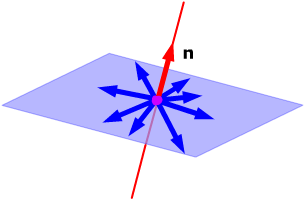
The set of all vectors $z$ that are orthogonal to $W$ is called the orthogonal complement of W and is denoted by $W^{\perp}$. $W$ is a subspace of $\mathbb{R}^n$, for example it is a plane in $\mathbb{R}^3$. The orthogonal complement of that plane would be the normal vector to that plane. Here's another example: If $W$ is a line in $\mathbb{R}^3$, then $W^{\perp}$ is the plane that is perpendicular to the line.
Orthogonal projection

Orthonormal set

An orthonormal set is orthogonal, but has one extra requirement: Every vector has length equal to 1.

If you construct a matrix $U$ with the vectors of an orthonormal set as columns, then $U^T U = I$. Why? Because matrix multiplication can be regarded as a set of dot product operations. Each column in $U$ dotted with any other column in $U$ will become zero, but a column in $U$ dotted with itself will become one. This also means that $U^{-1} = U^T$ if $U$ is square.

Projection

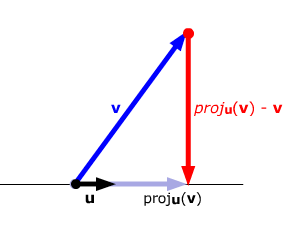
$\hat{y}$ is the vector $y$ projected down to the line $L$ spanned by the vector $u$ $$ \hat{y} = proj_L y = \frac{y \cdot u}{u \cdot u} u $$

Orthogonal projection

The Gram-Schmidt process

Let's say that you have a set of linearly independent vectors. The Gram-Schmidt process can orthogonalize these vectors.

Example:

$$ W = span \{ x_1, x_2, x_3 \} $$ $$ v_1 = x_1 $$ $$ v_2 = x_2 - \frac{x_2 \cdot v_1}{v_1 \cdot v_1} v_1 $$ $$ v_3 = x_3 - \frac{x_3 \cdot v_1}{v_1 \cdot v_1} v_1 - \frac{x_3 \cdot v_2}{v_2 \cdot v_2} v_2 $$

$ \{ v_1, v_2, v_3 \} $ is an orthogonal basis for $W$

QR factorization

If $A$ is an m x n matrix with linearly independent columns, then $A$ can be factored as $A = QR$. $Q$ is an m x n matrix whose columns form an orthonormal basis for $Col\:A$. $R$ is an upper triangular invertible matrix with positive entries on its diagonal.

You can use the Gram-Schmidt process for finding $Q$. When finding R, you can use the fact that the columns of $Q$ are orthonormal, and thus $Q^T Q = I$: $$ A = QR $$ $$ Q^T A = Q^T Q R $$ $$ Q^T A = I R $$ $$ R = Q^T A $$

Symmetric matrices

A symmetric matrix is a square matrix $A$ such that $A^T = A$.

For any symmetric matrix $A$, this is true: $A^T A = A A^T$

If $A$ is symmetric, then any two eigenvectors from different eigenspaces are orthogonal.

Useful links

Recap lecture (Norwegian)
Course videos (Norwegian)
Second order differential equations on Khan Academy
Linear algebra on Khan Academy
Official website with homework assignments, old exams etc.
Differential Equations explained

Written by

Stian Jensen cristea oyvindrobertsen iverjo trmd Solveig davidkas
Last updated: Thu, 4 Jun 2015 12:24:57 +0200 .
  • Contact
  • Twitter
  • Statistics
  • Report a bug
  • Wikipendium cc-by-sa
Wikipendium is ad-free and costs nothing to use. Please help keep Wikipendium alive by donating today!